
Designing a Monument Sign: It’s More Than Just a Pretty Box in the Dirt
If you’ve ever driven past a corporate campus, a sprawling subdivision, or a high-end shopping center, you’ve seen a monument sign. They are those substantial, ground-level structures that announce you’ve arrived somewhere important.
To the average observer, a monument sign looks like a nice piece of architecture with a logo on it.
But to the designers, engineers, and fabricators who build them, a monument sign is essentially a miniature commercial building. You don’t just draw a pretty rectangle in software and call it a day; you have to battle physics, underground utility mazes, and local zoning boards.
Here is the chaotic, highly technical, and occasionally hilarious process of designing a monument sign, from the first sketch to the final concrete pour.
The Site Survey & The Underground Minefield
Before anyone even thinks about picking colors or choosing fonts, you have to figure out where the sign is actually going to live. This phase is less about art and more about detective work.
- The Sight Triangle: Municipalities have strict rules about visibility. You can’t drop a 10-foot-tall brick wall right on the corner of a busy intersection, because drivers won’t be able to see oncoming traffic.
- The 811 Utility Roulette: This is the most critical step. Directly beneath that perfect patch of grass where your client wants the sign might be a high-pressure gas line, a water main, or the fiber-optic cable keeping the local internet running.
Because monument signs require massive, deep concrete footers, hitting one of these is catastrophic. The design must navigate around the neon spray paint of marked utilities. It usually looks a little something like this:
2. The Aesthetic Design (Making It Look Like It Belongs)
Once the safe zone is established, the actual artistic design begins. A great monument sign shouldn’t look like an alien spacecraft that crash-landed in the parking lot; it should look like a natural extension of the property.
- Architectural Harmony: If the office building is wrapped in red brick and standing seam metal, the monument sign should probably feature red brick and standing seam metal.
- Scale and Contrast: Because these signs are viewed by people driving by at 45 MPH, subtlety is not your friend. The design needs high-contrast elements—like bright, glowing push-through acrylic letters against a dark, matte background.
- Illumination Strategy: Will it have internal LEDs illuminating the letters? Will it have external ground spotlights washing up the textured stone base? The lighting design dictates how the sign is fabricated and how power needs to be routed underground.
3. Engineering & The Laws of Physics
This is where the pretty picture meets harsh reality. A monument sign is a large, solid object sitting outside 24/7, which means it acts exactly like a giant sail in a windstorm.
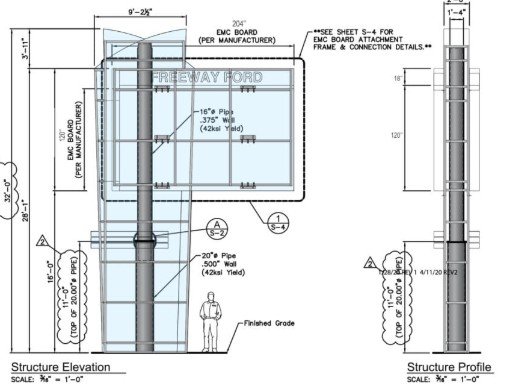
- Wind Load Calculations: Depending on the region, the sign must be engineered to withstand specific wind speeds. You have to calculate the exact thickness of the internal steel support pipes and the depth of the concrete footer required to keep the sign standing during a gale.
- The Foundation: You can’t just stick a sign this heavy in the dirt. The design must include a spec for a reinforced concrete foundation, often requiring holes dug 4 to 6 feet deep, filled with a rebar cage and structural concrete.
4. The Final Payoff (Installation)
Once the site plan, the aesthetic design, and the structural engineering stamps are combined into a master document, it goes to the city for permitting. The city planners will review every inch of the design to ensure it meets the local sign code.
Only after the city officially stamps the approval can the saws start spinning, the welders start sparking, and the concrete trucks start rolling.
To see what all that planning leads to, check out this wildly satisfying time-lapse of a monument sign actually going into the ground. Notice the heavy equipment, the massive steel posts, and the sheer amount of concrete it takes to make this happen:
Designing a monument sign is an intricate dance between creative branding, heavy-duty construction, and strict municipal law. But when it’s finally installed, standing solid and glowing beautifully in the night, all that paperwork and utility dodging is absolutely worth it.
Comments (0)
No comments yet. Be the first to comment.